
Are you facing an overwhelming battle right now that feels impossible to overcome on your own?
When sudden catastrophe threatens your peace, your family, or your future, terror naturally tries to grip your spirit. King Jehoshaphat faced this exact moment of sheer desperation when three massive allied armies marched across the desert to wipe his nation off the map. In the face of undeniable extinction, he did not rely on military strategy or political alliances; instead, he mobilized an entire nation around the prayer of Jehoshaphat for victory, unleashing divine power that dismantled the enemy without striking a single sword.
Your current crisis requires that same urgent pivot from panic to supernatural reliance. Whether you are dealing with an impossible financial shortfall, an aggressive health diagnosis, or relentless spiritual warfare, your situation is not beyond the reach of Almighty God. Understanding this ancient prayer unlocks the exact spiritual blueprint needed to turn impending defeat into a historic testimony of triumph.
The Anatomy of an Impossible Crisis: 2 Chronicles 20
The account recorded in 2 Chronicles chapter 20 opens with high-stakes urgency. Word reached King Jehoshaphat that a massive coalition composed of Moabites, Ammonites, and Meunites had crossed the Dead Sea and stood at En Gedi—just a short march from Jerusalem. There were no reserves to call, no defensive forts capable of halting such numbers, and no time to negotiate.
The Realism of Fear and the Decision to Seek God
Scripture does not hide the King’s humanity. Second Chronicles 20:3 explicitly states: “Jehoshaphat was afraid, and turned his attention to seek the Lord.” Fear came knocking, but Jehoshaphat refused to let fear dictate his response. He transformed his alarm into an urgent spiritual offensive by proclaiming a nationwide fast across Judah.
Most people react to crisis by exhausting their physical resources first, turning to prayer only as an afterthought when every other door slams shut. Biblical power operates in reverse. The moment Jehoshaphat realized his vulnerability, he immediately brought his community before the presence of God at the temple.
Radical Vulnerability Before Heaven
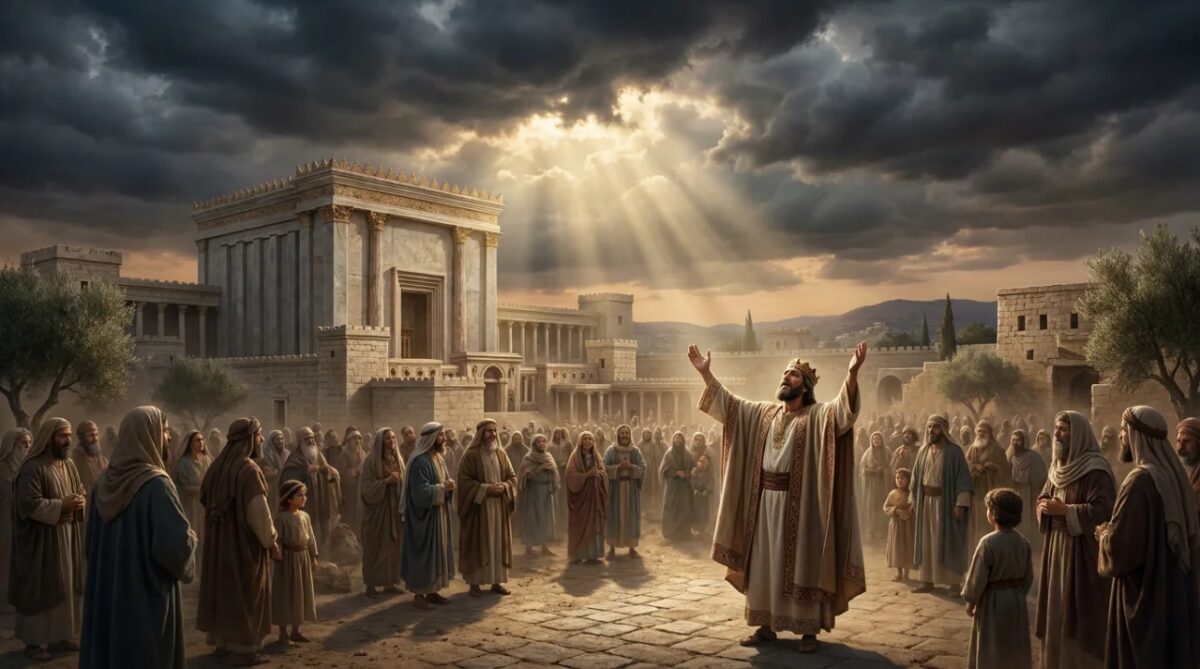
Standing in the assembly of Judah and Jerusalem, before the new court of the temple, Jehoshaphat lifted his voice. He did not present a polite, rehearsed petition; he presented an urgent plea rooted in covenant rights. Notice the progression of his words:
- He proclaimed God’s ultimate sovereignty: “Lord, the God of our ancestors, are you not the God who is in heaven? You rule over all the kingdoms of the nations.” (2 Chronicles 20:6)
- He recalled God’s historic covenant faithfulness: He reminded God of how He drove out inhabitants before Israel and promised to hear their cries in times of affliction.
- He exposed his complete dependence: “For we have no power to face this vast army that is attacking us. We do not know what to do, but our eyes are on you.” (2 Chronicles 20:12)
This final confession—admitting total human incapacity while locking eyes on God—is the divine trigger that activates heaven’s intervention.
| Human Reaction in Crisis | The Jehoshaphat Protocol |
|---|---|
| Panicking and seeking frantic earthly solutions | Immediately seeking God through fasting and prayer |
| Focusing intently on the size of the problem | Proclaiming the absolute supremacy and dominion of God |
| Pretending to be strong while internally terrified | Openly acknowledging helplessness before heaven |
| Trying to fight supernatural attacks with fleshly strength | Allowing God to position spiritual worship ahead of the fight |
Deconstructing the Prayer of Jehoshaphat for Victory
To apply the prayer of Jehoshaphat for victory to your life today, you must understand the theological mechanics that made it so effective. Jehoshaphat did not bargain with God; he anchored his urgent plea to three unchangeable pillars.
1. Anchoring in Omnipotence and Divine Jurisdiction
Before mentioning his enemies, the king magnified God’s absolute authority. He acknowledged that no kingdom on earth possesses authority that exceeds the Creator’s dominion. When you begin your prayers by celebrating the majesty of God, your impossible problem immediately shrinks in perspective.
2. Pleading the Covenant Promises
Jehoshaphat reminded the Lord that Israel stood in the land because of a covenant promise made to Abraham. God is legally bound by His own Word. When you approach the throne of grace during an emergency, you are not begging as a stranger; you are claiming the redemptive rights secured through Jesus Christ. Pointing to Scripture during prayer is not informing God of what He forgot; it is demonstrating that your faith rests on His immutable character.
3. The Power of Absolute Surrender: ‘Our Eyes Are on You’
Spiritual breakthrough stalls whenever you maintain a backup plan. The phrase “we do not know what to do, but our eyes are on you” represents total surrender. It strips away pride, carnal intellect, and self-reliance. It is in this posture of holy surrender that God’s strength is made perfect in human weakness.
The Prophetic Turn: ‘The Battle Is Not Yours, But God’s’
As the entire congregation of Judah stood weeping and praying—men, women, and little children—the Holy Spirit fell upon Jahaziel, a Levite of the sons of Asaph. In the midst of the assembly, Jahaziel spoke words that still echo through history with supernatural authority:
“Do not be afraid or discouraged because of this vast army. For the battle is not yours, but God’s. Tomorrow march down against them… You will not have to fight this battle. Take up your positions; stand firm and see the deliverance the Lord will give you.” — 2 Chronicles 20:15–17
Standing Firm in Spiritual Alignment
Taking your position does not mean retreating into passive apathy. In spiritual warfare, taking your position means standing rooted in faith, clothed in the armor of God, refusing to flee from the enemy’s intimidation. When God declares that the battle belongs to Him, He assumes full legal and spiritual responsibility for the outcome.
The Strategic Deployment of Radical Praise
The following morning, Jehoshaphat gave an instruction that defies every principle of military strategy. After consulting with the people, he appointed singers to lead the army, dressed in holy attire, singing:
“Give thanks to the Lord, for His loving kindness is everlasting.”
They marched straight toward the wilderness of Tekoa, singing praises before the armed soldiers. Look closely at what Scripture records in verse 22: “At the moment they began to sing and praise, the Lord set ambushes against the men of Ammon and Moab and Mount Seir who were invading Judah, and they were defeated.”
Praise is not a musical intermission; it is an aggressive spiritual weapon. When you worship God in the face of impossible odds, you release confusion into enemy camps. The allied armies turned against each other in total chaos, completely destroying one another before Judah ever reached the battlefield.
The Valley of Berachah: Collecting Spoils from the Crisis
When Judah arrived at the lookout point in the wilderness, they saw only fallen bodies covering the ground. Not a single enemy had escaped. The crisis that threatened to wipe out their existence ended up transferring immense wealth into their hands.
Three Days of Gathering Blessings
Second Chronicles 20:25 reveals that Jehoshaphat and his men found such an abundance of equipment, garments, and valuable items that it took them three full days to collect all the plunder because there was so much. On the fourth day, they assembled in the Valley of Berachah (which means the Valley of Blessing), where they praised the Lord.
God does not merely bring you through trials to restore you to baseline survival; He uses the very attack launched against you to enrich your spiritual authority, strengthen your faith, and provide supernatural abundance. The very battle intended to destroy you will become the source of your greatest testimony.
Step-by-Step Template: Praying the Prayer of Jehoshaphat Today
When facing an urgent crisis, speak this prayer boldly and aloud, declaring your reliance on the living God:
- Step 1: Declare God’s Supremacy. “Almighty God, Creator of heaven and earth, You rule over every power, authority, disease, and demonic scheme. No weapon formed against me can stand against Your sovereign dominion.”
- Step 2: Acknowledge Your Helplessness. “Lord, I admit that in my own flesh, I have no power against this situation. I do not possess the wisdom or strength to conquer this crisis on my own. I lay down my anxiety, my control, and my desperate plans.”
- Step 3: Fix Your Eyes on Jesus. “My eyes are locked on You, Jesus. You are my Deliverer, my Shield, and my High Tower. I refuse to look at the size of the storm, choosing instead to gaze upon the majesty of Your throne.”
- Step 4: Release Radical Praise. “Father, I thank You that the battle is not mine, but Yours. I praise You right now before I see the physical breakthrough. I praise You because Your mercy endures forever, and You have already set ambushes against every work of darkness targeting my life. In the mighty name of Jesus, Amen.”
Perguntas Frequentes: Frequently Asked Questions
What makes the prayer of Jehoshaphat uniquely effective for urgent crises?
The prayer of Jehoshaphat addresses emergency circumstances by removing self-reliance and shifting the burden of conflict directly to God. By combining fasting, open admission of weakness, remembrance of God’s covenant, and immediate praise, it activates divine intervention where human effort has failed.
Why did Jehoshaphat place singers in front of the army instead of warriors?
Placing worshipers ahead of warriors was a physical declaration that faith in God’s promise superseded natural combat prowess. Worship acts as an offensive spiritual weapon that invites the presence of God, and God’s presence inherently causes enemy strongholds to crumble into confusion.
How can I say ‘the battle is not mine’ while still fulfilling my responsibilities?
Declaring that the battle belongs to God does not mean ignoring practical duties like working, seeking medical counsel, or paying debts. It means you release the internal panic, spiritual burden, and outcome into God’s sovereign hands, acting with wisdom while trusting Him alone for the ultimate deliverance.
What does the ‘Valley of Berachah’ mean for believers today?
The Valley of Berachah represents the transformation of a battlefield of terror into a valley of blessing. For modern believers, it signifies that when you trust God through an impossible trial, the spiritual and practical outcome will leave you stronger, more prosperous in faith, and overflowing with gratitude.
Stand Firm and Watch God Win Your Battle Today
You no longer need to carry the crushing weight of a war you were never designed to fight alone. Take your position right now, abandon the exhausting strategies of the flesh, and fix your gaze entirely upon the Lord. Open your mouth and release fervent praise into the atmosphere of your home, your workplace, and your family. Step boldly into the victory God has already prepared for you, and watch Him turn your greatest trial into your valley of everlasting blessing.